If your mixes fall apart on other speakers, studio monitor placement is a likely culprit. Put you and the monitors in an equilateral triangle, tweeters at ear height, along the shortest wall, then adjust by ear.
Monitor position is one of the cheapest upgrades in any home studio, because it costs nothing but time.
| Item | Starting value |
|---|---|
| Listening position in a rectangular room | 38% of the way in from the shortest wall |
| Minimum gap from speaker back to rear wall | 60 cm (about 2 feet) |
| Minimum distance between you and either speaker | 1 meter |
| Triangle apex behind your head | about 0.5 meters |
| Tweeter height | Ear level |
These figures come from Kali Audio’s speaker positioning guide. Guidance can change, so check the source before you rely on the numbers.
Studio monitor placement starts with the triangle and the shortest wall
Place your speakers along the shortest wall and face into the room. This layout helps keep the listening seat away from bass buildup at the room’s rear boundary.
Then form an equilateral triangle between the two speakers and a point about 0.5 meters behind your head. Each speaker should be the same distance from that point as the speakers are from each other.
Keep at least 1 meter between you and either speaker, and keep objects out of the line between you and them. Sit centered between the side walls so the stereo image stays balanced.
If your room is very narrow, Universal Audio’s guide says you may have to place the speakers along one of the widest walls instead, to avoid side wall reflections. That is the exception, though; start with the short wall and only switch if the sound tells you to.
Set height and angle
Line up the tweeters at about ear level, or tilt the monitors so they aim at your ears. Universal Audio’s guide also says it is best to keep speakers above or below the midpoint between floor and ceiling, and you can tilt them to aim the tweeter at your ear.
Toe-in is the next step. Kali suggests starting the speakers around 2 meters apart with no toe-in, then, at about 1.5 meters, gently toeing them in until the track feels properly centered.
Do not overdo it: Kali warns against toeing the speakers in too much. Small changes and a familiar track are enough to hear whether a centered vocal really sits in the middle.
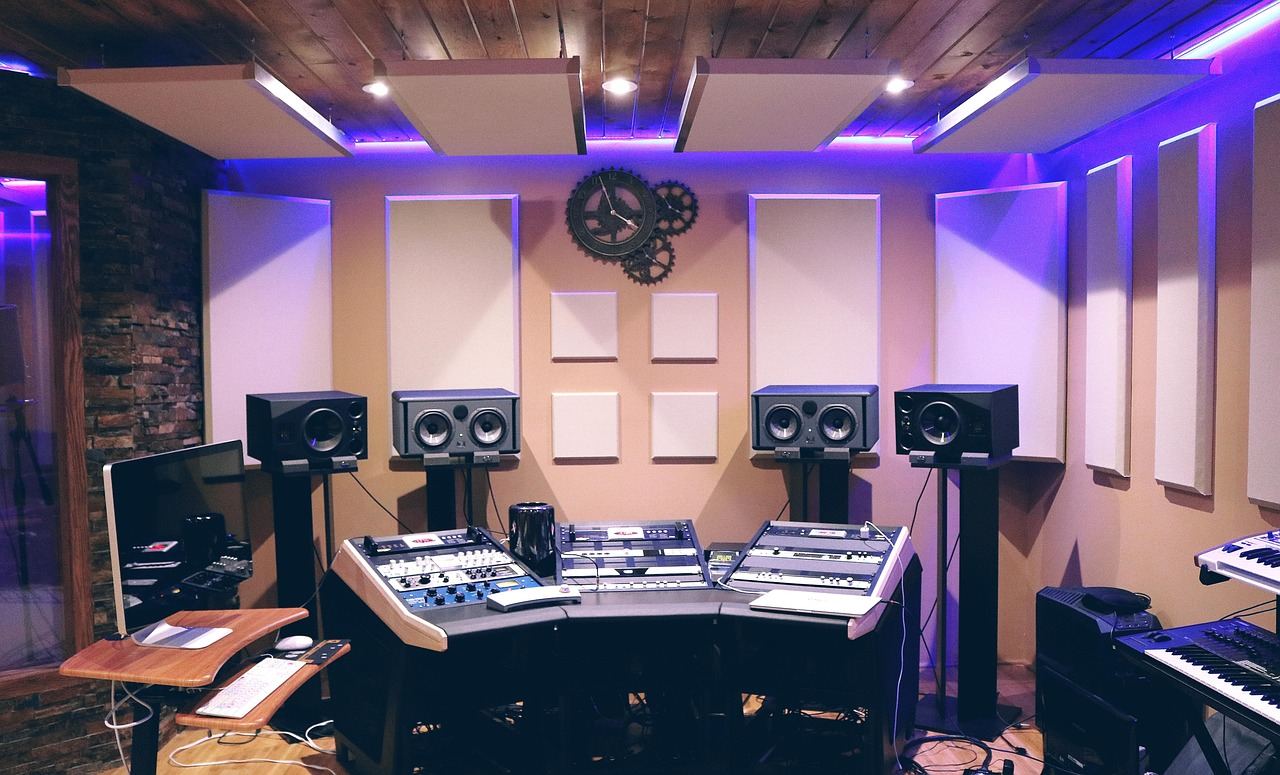
Why nearfield and decoupled stands help
Nearfield monitoring means you hear more of the speaker and less of the room’s reflections. Universal Audio gives a typical nearfield listening distance of three to five feet for smaller studios.
Universal Audio recommends separate, mechanically isolated speaker stands behind the desk. If a desk is your only option, the points above still apply: keep the tweeters near ear height and keep the line between speaker and ear clear.
- Clear the desk space between you and each speaker.
- Keep both monitors the same height and angle.
- Make sure stands or desk pads are stable, so nothing rattles at high volume.
Where to sit: the 38% rule
For rectangular rooms, Kali suggests testing a seat position 38% of the room’s length from the shorter front wall. Kali credits it to studio designer Wes Lachot.
Treat it as a first test position, not a guarantee. Real rooms have doors, windows and furniture, so move a little either side and listen to a bassline to see where the low end sounds most even.
Universal Audio makes a related point: room-tuning software can predict where troublesome modes are likely to occur, but putting your monitors on stands and playing some music is an easy way to find out what you are dealing with. The effect depends on your listening position and on where the speakers sit.
Keep speakers away from walls and corners
Bass radiates behind the speaker too, so a nearby wall reflects some of that energy toward the listener. That adds bass peaks and dips at your ears.
Kali calls this the boundary effect: sound reflecting off the wall behind your speakers interferes with the signal coming from the speakers. Its advice, via Lachot, is a minimum of 60 cm (about 2 feet) from the back of the speakers to the back wall.
Universal Audio adds a trick: make the distance from the back of the speaker to the rear wall different from the distance to the side wall and to the floor or ceiling, which randomizes the peaks and troughs.
- Match each speaker’s distance to its side wall so the image stays centered.
- Avoid corners, where bass builds up.
- Use stands or a desk setup that keeps tweeters near ear height.
A simple routine for setting up
- Pick the shortest wall and center the speakers on it.
- Pull the speakers at least 60 cm (about 2 feet) from the rear wall.
- Sit about 38% of the way into the room, centered between the side walls.
- Build the triangle, with tweeters at ear height.
- Toe in gently until a centered sound really sounds centered.
- Listen to familiar tracks and nudge your seat or the speakers in small steps.
Expect to repeat this once or twice. Your room and your ears are the real test, and the numbers above are only where you begin.
Placement only goes so far
Good placement reduces room problems, but it cannot remove them. Reflections can create peaks and nulls in the frequency response, so pair your layout with acoustic treatment once the speakers are in the right spots.
Kali recommends addressing boundary interference through positioning and absorption before using EQ for further correction.
Once positioned, check that your audio interfaces feed both monitors at matched levels, so that an uneven image is not a gain problem. Then play familiar tracks and adjust in small steps.
Frequently asked questions
Do I need the equilateral triangle exactly?
Show answer
No. Kali notes that a lot of people online recommend it, so treat it as a starting layout and adjust by listening.
Should tweeters be at ear level?
Show answer
That is the usual target. Kali suggests aligning tweeters approximately at ear level, or tilting the monitors to aim at your ears.
How far should monitors sit from the back wall?
Show answer
Kali’s guide, citing Wes Lachot, advises a minimum of 60 cm (about 2 feet) from the back of the speakers to the back wall.
Does the 38% rule work in every room?
Show answer
It is a rule for rectangular rooms “on paper”, so use it as a starting test position and confirm by ear.